
OnlyFans Scam Messages: How to Recognise Them
Scam messages on OnlyFans are not random. They follow scripts, and once you can name the script you are reading, the message loses most of its power. This article breaks down the common formats, the pressure tactics behind them, and the practical steps that end the conversation safely.
Most subscribers meet these messages in the same place: the direct message inbox, which on OnlyFans is the only channel a stranger can use to reach you. There is no public feed or comment section where a scammer can be spotted and challenged by other users. That privacy protects creators, but it also means a dishonest account can repeat the same script for months without public correction.
A ranking service such as BestOnlyFans exists partly because the platform offers no directory of its own. These sites compare public profile prices, promotions, posting activity and media counts so subscribers can judge an account before spending anything. They do not measure payments and they cannot see private messages, so treat them as a starting point rather than a guarantee.
Why scam messages work
Two emotions do most of the work: urgency and flattery. Urgency removes the pause in which you would normally check an account, and flattery makes the request feel personal rather than generic. A message that combines both is worth reading twice before you act on it.
The table below sets out the signals that separate a normal promotional message from a suspicious one. The comparison column matters more than the signal itself, because most of these phrases appear in legitimate messages too.
| Signal | Normal message | Suspicious message |
|---|---|---|
| Timing | Sent during normal posting hours | Sent at 3am with a countdown attached |
| Offer | Describes what is included | Describes what you will lose by waiting |
| Payment | Points to the platform checkout | Asks for a transfer or gift card |
| Identity | Matches the public profile | Claims to be an assistant or manager |
| Language | Consistent with older posts | Sudden change in tone or spelling |
| Request | Invites a subscription | Requests personal details or ID |
Practical tip: before replying to any offer, open the creator’s profile in a second tab and check the price, the posting dates and the media count. If the message describes an account that does not match what you see, stop there.
Common scam scripts
Scripts repeat because they work. Recognising the category is faster than analysing each individual sentence, and it lets you skip the whole message rather than arguing with it.
- The expiring offer: a discount that ends within minutes and is never mentioned on the public profile.
- The fake assistant: a second account claiming to manage messages for a creator you already follow.
- The prize message: a claim that you won a giveaway you never entered.
- The leaked content pitch: an offer to sell a full archive at a fraction of the listed price.
- The verification request: a demand for a photo of your ID to confirm your age or account.
- The off-platform move: a request to continue the conversation on another app.
Each script has a different opening, but they converge on the same ending. At some point the message asks you to pay outside the platform, share credentials, or send personal information. That convergence is the single most reliable indicator you will ever get.

Pressure tactics decoded
Pressure tactics are borrowed from sales, not from scams specifically, which is why they feel familiar. Knowing the phrase behind the tactic makes the intent visible.
| Phrase | Tactic |
|---|---|
| Only three spots left | Artificial scarcity |
| I noticed you looking at my page | Manufactured familiarity |
| This offer disappears in ten minutes | Countdown pressure |
| Do not tell anyone about this | Isolation from other users |
| I will send it once you confirm | Conditional reward |
| Everyone else already claimed theirs | Social proof, invented |
None of these phrases is illegal on its own, and some legitimate promotions use mild versions of them. The pattern to watch is speed: a message that pushes you to decide within minutes is designed to prevent comparison.
Fake offers and prizes
Free unlocks and giveaways delivered by direct message are almost always scams, because a real promotion is announced publicly where everyone can see it. A private prize that only you received is not a promotion; it is a hook.
The economics also do not fit. A free page sets its subscription price to $0 and earns through pay-per-view messages and tips, while a paid page charges somewhere between $4.99 and $49.99 per month, with most pages sitting in the $4.99 to $15 range and a typical average between $5 and $10. There is no base price below $4.99, so any message offering a permanent subscription far cheaper than that is describing something the platform does not support.
Walk away when you see any of the following:
- A prize you cannot find mentioned anywhere on the public profile.
- A request to pay a small fee to release a larger reward.
- An offer to unlock content in exchange for a screenshot of your payment details.
- A claim that the offer is limited to you personally.
- A link shortener instead of a platform page.
- Any request for your login credentials.
Link and payment traps
The goal of most scam messages is to move you off the platform, because the platform’s checkout and messaging history are the two things that protect you. Once a payment leaves the site, there is no record to dispute and no support route to follow. A practical starting point is best onlyfans deals, which lists pages by the signals above.
If a message contains a link you do not recognise, work through these steps in order rather than improvising:
- Do not click the link. Close the message and return to the inbox later.
- Open the creator’s profile directly and check whether the offer appears there.
- Compare the account name with the name in the message, character by character.
- Ignore any request for a bank transfer, gift card or cryptocurrency payment.
- Never enter your login details on a page reached from a message.
- Report the message using the option inside the conversation.
- Block the account so the script cannot continue.
One detail is worth knowing because it explains why scammers rush you: when a creator raises a subscription price, auto-renew stops, and existing access lasts only until the current paid period ends. A message that claims your access will vanish unless you pay immediately is misusing a real mechanic to create false panic.
Reporting and blocking
Reporting is simpler than most subscribers expect. Open the conversation, use the report option attached to the message or the account, choose the closest category, and submit. Blocking is a separate action, and doing both is the reliable combination.
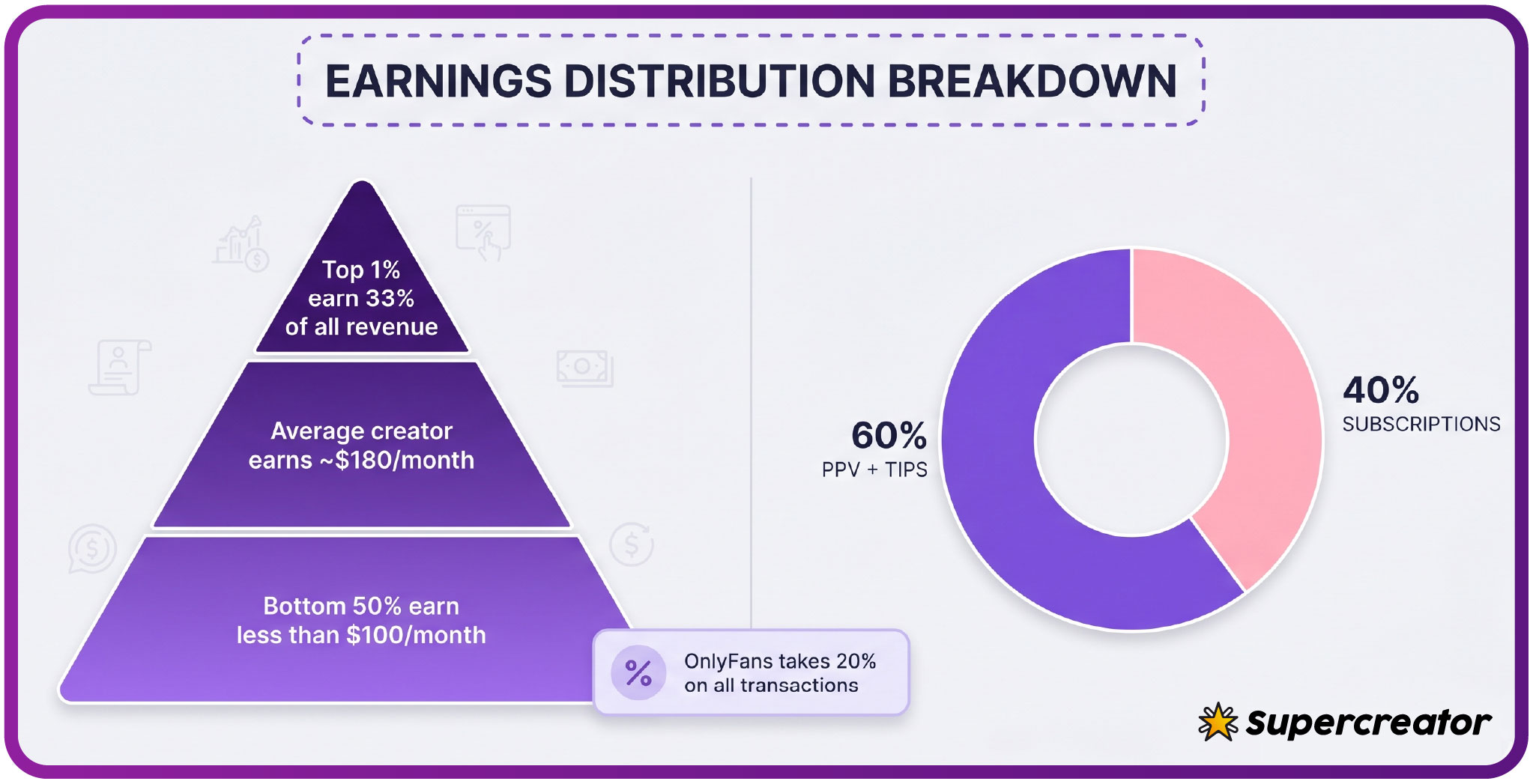
The platform takes a 20% fee on everything, including subscriptions, tips and pay-per-view purchases, and the creator keeps 80%. That split is a useful reference point when a message claims a creator receives nothing unless you pay through an outside route, which is not how the system works.
Before you subscribe to anything, it helps to know what a normal month looks like. A service that ranks accounts, such as the one behind best onlyfans deals, compares public profile prices, promotions, activity and media counts so the numbers below are easier to check.
- Minimum paid subscription: $4.99 per month.
- Maximum paid subscription: $49.99 per month.
- Typical paid range: $4.99 to $15 per month.
- Common average: $5 to $10 per month.
- Free page subscription: $0, with earnings from pay-per-view and tips.
- Promotional first months: occasionally below $4.99, never a permanent base price.
Guidance on staying safe on OnlyFans covers privacy settings as well as payment hygiene.
Recovering after a scam message
If you clicked a link or shared details, act quickly rather than quietly. Change your password, enable two-step authentication, and review any payment method connected to the account. Speed matters more than dignity here.
Then check what was actually exposed. A clicked link with no form filled in is a minor event; a submitted password or card number is not. Record the account name and the message text before you block, because the conversation disappears from your inbox once the block is complete.
A ranking site like BestOnlyFans can help you rebuild a shortlist of accounts with visible activity and clear pricing, but it cannot reverse a payment or recover an account. Use it for comparison, not for recovery. The mistakes to avoid at this stage are predictable:
- Paying a second time because the first payment was called incomplete.
- Sharing a verification code with anyone who asks for it.
- Continuing the conversation to gather evidence before blocking.
- Reusing the same password on other sites.
- Assuming the account will stop messaging once you ignore it.
- Keeping the payment method active without reviewing recent charges.
Recovery is mostly about closing doors: the password, the payment method, the conversation, and the account. Once those are shut, the script has nowhere left to go.
BestOnlyFans refreshes its rankings every month.
FAQ
Are scam messages on OnlyFans common?
They are common enough that most long-term subscribers encounter at least one, particularly on free pages where messaging is open to more accounts.
Can a creator send a legitimate discount by direct message?
Yes, but a genuine promotion usually appears on the public profile as well, so the message and the profile should describe the same price.
What should I do if the message asks me to pay outside the platform?
Do not pay. Report the message, block the account, and keep any payment inside the platform checkout where a record exists.
Does blocking stop the messages completely?
Blocking ends that conversation, but a determined sender can create another account, so treat unfamiliar messages with the same caution afterwards.